Humanize AI Writing While Keeping Your Voice Intact
The ReverseGPT Team·September 15, 2026·9 min read
Frequently asked questions
What does it mean to humanize AI writing?
Humanizing AI writing means revising generic or mechanical prose so it serves your point, audience, and purpose. It involves clarifying claims, removing empty phrasing, and taking responsibility for the final wording and evidence.
How can I tell whether an AI draft needs revision?
A draft likely needs revision when it is fluent but interchangeable, relies on stock phrases, repeats sentence patterns, uses vague transitions, or lacks context and judgment. Clean grammar does not ensure that the reasoning is specific or useful.
How do I keep the original meaning while rewriting?
Identify the central claim, key evidence, qualifications, attribution, and logical sequence before changing the language. You can revise structure and wording, but should not alter the claim, certainty, source relationship, or conditions that support it.
What should I check after using a rewrite tool?
Review every changed passage against your purpose and source material. Confirm that qualifications remain accurate, replace unsupported generic examples, add your own analysis and citations, and make sure you can stand behind every claim.
When is humanizing a draft not enough?
Humanizing is not enough when the draft lacks research, evidence, a clear central claim, relevant examples, or a logical structure. In those cases, return to the underlying work by researching further, reorganizing, or drafting from a new outline.
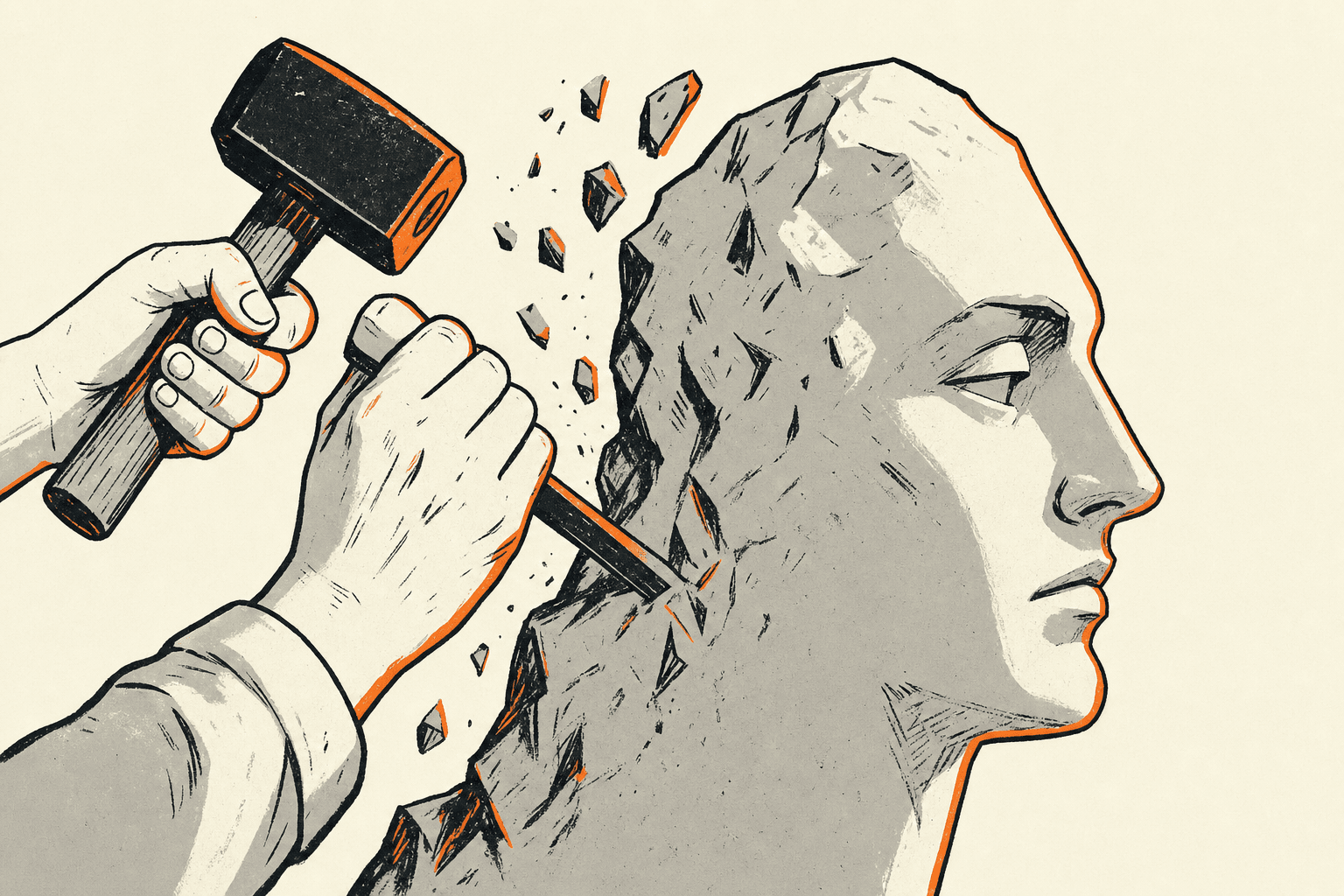
To humanize AI writing is to revise it until the language serves your actual point, audience, and purpose. The goal is not to conceal where a draft started. It is to make sure the finished prose reflects your judgment and that you can stand behind every claim in it.
What Does It Mean to Humanize a Draft?
Humanizing is the process of revising generic or mechanical prose into writing that sounds purposeful, specific, and appropriate for its reader.
An AI-assisted draft can give you a starting structure, a list of points, or a rough explanation. It can also produce language that sounds polished without saying much. Humanizing asks you to look past that surface polish. You clarify the claim, remove empty phrasing, and choose words that fit the situation.
That is different from changing authorship or disguising work. A revised draft still needs to be yours in the meaningful sense: you understand its argument, verify its evidence, and make the final decisions. If you cannot explain why a sentence is there, what it means, or where its factual claim came from, the sentence is not ready to publish.
Humanizing also does not mean adding confidence where the draft lacks support. A vague claim should become more precise, not more sweeping. If a draft says that a policy “dramatically improved outcomes,” you need to know which outcomes, for whom, and based on what evidence. Sometimes the responsible revision is to narrow the claim. Sometimes it is to remove it.
A useful revision keeps the writer accountable for:
The central argument and its limits
Facts, figures, examples, and source attribution
The tone appropriate to the assignment or publication
The final wording submitted under the writer’s name
The result should not merely sound less formulaic. It should say what you mean.
Signs an AI Draft Needs Revision
An AI draft needs revision when its sentences are fluent but interchangeable.
Many generated drafts follow a predictable pattern. They introduce a broad idea, restate it in slightly different words, add a general transition, and close with an equally broad conclusion. The grammar may be clean. The reasoning may still be thin.
Look for these common problems when you edit AI-generated text:
Repeated sentence patterns. Several sentences may begin with “This,” “It is important,” or “In today’s world.” The rhythm becomes flat because each sentence does the same job in the same way.
Vague transitions. Phrases such as “Furthermore,” “Moreover,” and “In conclusion” can signal movement without explaining the relationship between ideas.
Stock phrases. “A crucial role,” “a wide range of,” “ever-evolving landscape,” and “it is worth noting” often add length without adding meaning.
Overexplaining obvious points. A draft may spend a full paragraph defining an idea your intended reader already understands.
An overly even tone. Every point receives the same level of emphasis. Nothing sounds chosen, challenged, qualified, or connected to a real concern.
Missing judgment. The draft presents possible views but does not tell the reader which interpretation is better supported and why.
Missing context. It gives a general statement where the reader needs a concrete example, a relevant condition, or an explanation of stakes.
Polished grammar alone does not make ai writing sound natural. A grammatically correct sentence can still be evasive, inflated, or detached from the reader’s needs.
Consider a sentence that sounds formal but says little:
Before
It is important to note that effective communication plays a crucial role in fostering successful collaboration among team members.
After
Teams collaborate better when people state decisions, deadlines, and concerns clearly.
The revised version is shorter, but brevity is not the point. It names the behavior that matters. It gives the reader something they can recognize and use.
A human writing style also reflects audience awareness. A professor may expect careful qualifications and cited evidence. A client may need a direct recommendation and a clear next step. A public-facing article may need plain language before it needs technical detail. A draft cannot meet those needs simply by sounding smooth.
A Practical Process to Humanize AI Writing
The best way to humanize a draft is to revise the argument before you revise the phrasing.
Start with the assignment or publishing goal. Read the prompt, brief, or editorial request beside the draft. Then ask whether the draft actually answers it. A response can contain relevant information while still missing the required task.
Before you start sentence-level edits, identify:
The claim you need to make
The reader you need to reach
The evidence needed to support the claim
The action, conclusion, or understanding the reader should leave with
Any limits you need to acknowledge
This prevents a common mistake in humanizing: making weak content sound more elegant. Clearer wording cannot repair a missing argument.
Replace general language with actual reasoning
Once you know what the draft must do, find broad statements and make them earn their place.
A sentence such as “Remote work has changed the modern workplace” may be true in a broad sense, but it does not tell the reader anything useful. You might replace it with a narrower claim about the issue your piece addresses: how managers document decisions, how teams set availability expectations, or how new employees learn informal practices.
Specificity often comes from adding one of these elements:
A concrete example
A reason for the claim
A condition or exception
A clear subject that performs an action
A consequence that matters to the reader
Do not add details merely to make the paragraph look richer. Add details that move the argument forward.
Vary structure only when it helps the reader
Sentence variety matters because repetition can make prose feel programmed. But you do not need to force a different structure into every line.
Use a short sentence after a dense explanation. Combine closely related ideas when separate sentences make the paragraph choppy. Move a qualifying phrase to the beginning when the condition matters before the claim. Keep a repeated structure when it creates useful emphasis.
The question is not whether each sentence looks different. The question is whether the reader can follow the thought without friction.
Cut filler and check the facts
Filler often hides in introductory phrases, unnecessary intensifiers, and vague conclusions. Cut phrases such as “it should be noted,” “in many ways,” or “there is no doubt that” unless they do real work.
Then verify every factual claim. Check names, dates, definitions, quotations, and source descriptions against reliable material. If you cannot verify a claim, either research it properly, qualify it, or remove it.
Finally, read the draft aloud. You will hear problems your eyes skip over: stacked clauses, awkward repetition, unexplained leaps, and sentences that run past their point.
Read one paragraph at a time aloud. Mark the first place where you lose the thread or run out of breath. That is usually a revision problem, not a reading problem.
Keep the Original Meaning While Rewriting
To preserve meaning when rewriting, identify what cannot change before you edit the language around it.
A responsible rewrite can change sentence order, vocabulary, transitions, and emphasis. It should not quietly change the claim, evidence, or level of certainty. This is especially important when you are revising analytical, academic, legal, technical, or policy-related writing.
Start by marking the draft’s core parts:
Central claim: What does the piece argue?
Key evidence: Which facts, examples, or sources support that argument?
Qualifications: Where does the writer limit the claim or acknowledge uncertainty?
Attribution: Who made a statement, reached a finding, or holds a view?
Logical sequence: How does one point lead to the next?
You can then revise the language without losing the underlying structure. For example, a paragraph may move from a claim to evidence to interpretation. You can make the transitions more direct and remove repetition while retaining that progression.
Watch closely for changes that alter meaning by accident.
A rewrite can broaden scope when it changes “some employees” to “employees.” It can add certainty when it changes “may contribute to” to “causes.” It can remove attribution when it turns “the report argues” into a flat statement of fact. It can also distort a source by shortening a careful qualification into a stronger conclusion.
These are not small stylistic changes. They change what the draft says.
When a sentence includes a source, keep the relationship between the source and the claim clear. If the source provides an example, do not rewrite it as proof of a universal rule. If a claim depends on a condition, keep the condition in view.
A good ai draft revision makes the reasoning easier to inspect. It does not make the reasoning harder to trace.
How ReverseGPT Fits Into a Responsible Revision Workflow
ReverseGPT can help you revise AI-generated text into more natural writing while retaining its intended meaning.
You can paste a draft into the Humanizer and use the result as a revision pass rather than a final answer. The wording changes while the draft’s general structure and meaning remain in place. That can be useful when the original feels repetitive, stiff, or overloaded with generic phrasing.
The useful work still happens after the rewrite. Review the output against your original purpose and source material. Check that key qualifications remain accurate. Replace generic examples with details you can support. Restore any precise language that matters to your field, assignment, or audience.
The browser-based Editor can then support another pass with grammar and style suggestions, paraphrasing, and document editing. If you need to work through a draft over time, your documents are saved to your account. You can also review the available plans on the pricing page.
A responsible workflow looks like this:
Draft or gather your initial material.
Confirm the argument, audience, and required evidence.
Use a rewrite tool to help make the prose less mechanical.
Review every changed passage for meaning and accuracy.
Add your own analysis, examples, and properly cited sources.
Edit for clarity, grammar, and style.
Read the final version as the person responsible for publishing it.
The tool can assist with language. It cannot decide whether your evidence is sufficient, whether your conclusion is fair, or whether a sentence represents your own considered view.
Humanizing is not enough when the draft has a content problem rather than a language problem.
A smoother version of a weak draft is still weak. If the piece lacks research, skips necessary evidence, or fails to answer its central question, you need more than a rewrite. You need to return to the underlying work.
Start over, reorganize, or research further when:
The central claim is unclear or unsupported
The draft relies on broad assertions instead of evidence
Important counterarguments or limitations are missing
The order of ideas makes the reasoning difficult to follow
The examples do not fit the audience or purpose
The draft repeats information instead of developing it
You cannot verify key factual statements
Sometimes the best revision is a new outline. Write the claim at the top, list the evidence beneath it, and decide what each paragraph must contribute. Then draft from that structure. This is slower than polishing a generated paragraph, but it produces writing with a clearer point of view and a more defensible argument.
For academic work, follow your course rules and cite the sources you use. Treat generated text as a starting point for accountable revision, not as a substitute for reading, analysis, or authorship. Your instructor may have specific expectations about disclosure, permitted tools, source use, and the kind of assistance allowed.
The same principle applies to professional writing. If your name is on the document, you need to know what it claims and why. Humanizing helps when it makes a draft clearer, more specific, and more recognizably yours. It is not a replacement for the judgment that makes writing worth publishing.